
The challenge
Hundreds of partner fund requests required invoice validation, asset checks, policy verification and budget reconciliation. Inconsistent documentation and manual handoffs created delays and limited visibility into audit status.
The approach
The audit process was mapped with the people doing the work, separating repetitive validation from decisions that required professional judgment.
Automated intake, AI-assisted content verification and rule-based compliance checks surfaced exceptions for review. Dashboards made audit progress visible, while approval workflows connected the process with internal collaboration tools.
The operating principle was to help auditors concentrate on flagged submissions and exceptions, using automation to organize evidence and accelerate review.
- 01Receive evidence
- 02Check requirements
- 03Flag exceptions
- 04Review and approve
The outcome
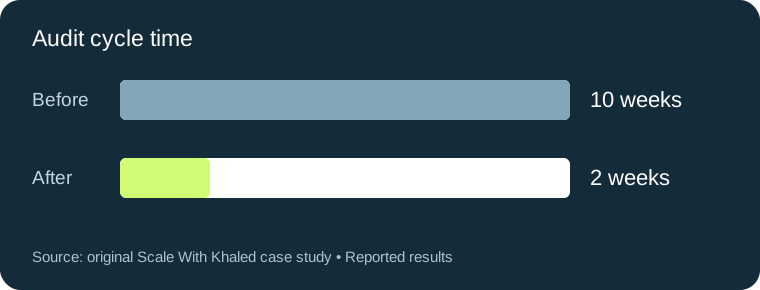
The published case reports the audit cycle falling from ten weeks to two, alongside an 85% reduction in manual review. The cycle-time change is equivalent to an 80% reduction; it is a different measure from the manual-review figure.

8 Weeks
Microsoft Power Automate, Microsoft Excel, OpenAI, Microsoft Teams
Source & measurement notes
Rewritten from the original Scale With Khaled project ↗. Figures are reported in that portfolio and have not been independently audited. Comparison periods and measurement limits are preserved where provided.
Banner: AI-generated conceptual artwork. Any original portfolio imagery shown below remains attributed to its source.