Build the proposition around a buyer’s ability to open, operate and expand reliably—not around the size of the global AI story.
Marketing a data center solution in the Middle East and Africa starts with a difficult distinction: demand for digital services does not automatically become a purchase order for your equipment. Between the headline and the order sit power availability, technical approvals, financing, site readiness and the buying organization’s tolerance for risk. A strong campaign helps the customer move through those decisions.
What the growth figures actually tell us
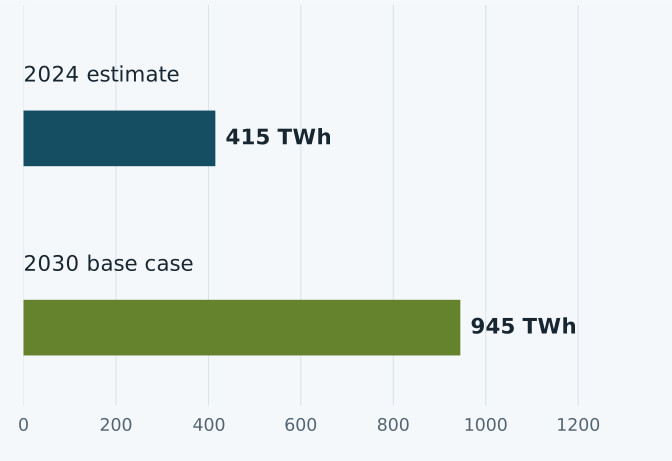
The IEA estimated global data center electricity use at 415 TWh in 2024 and projected about 945 TWh in its 2030 base case. These are global energy figures—not MEA revenue forecasts. [1] Separately, AWS announced more than US$5.3 billion of planned investment in Saudi Arabia in March 2024. That announcement signals commitment; it does not disclose the portion available to a particular local supplier. [2]
The global electricity backdrop
Data center electricity consumption · TWh
View chart data
| Measure | Value |
|---|---|
| 2024 estimate | 415 TWh |
| 2030 base case | 945 TWh |
Treat these numbers as a reason to investigate qualified demand. Do not multiply a global forecast by an assumed regional share and call the result your addressable market. Instead, build an account list from identifiable projects, procurement routes and the systems your organization can genuinely supply and support.
Start with the decision that needs evidence
A developer evaluating a site needs a different conversation from an operator replacing cooling equipment. A consultant may be assessing technical fit before a contractor has even been appointed. The marketing plan should identify the next decision at each account and the evidence required to make it.
- For the developer, explain delivery dependencies, expansion options and the commercial assumptions behind the proposal.
- For the engineering consultant, provide current technical documentation, interfaces and clear application limits.
- For the operator, demonstrate maintainability, service coverage and how an incident would be escalated.
- For procurement, make the scope, exclusions, lead-time assumptions and warranty responsibilities easy to compare.
These are recommended planning categories, not a claim that every project follows the same approval sequence. Interview the account team before choosing the content format.
Make local delivery part of the offer
Regional branding can open the conversation, but local capability needs proof. A support map should distinguish employed engineers from subcontracted coverage, stocked parts from items ordered on demand, and contractual response commitments from informal expectations. A distributor logo is not evidence that the whole service chain is ready.
For a campaign landing page, show the application, the customer problem, the relevant system boundaries and a route to a technical discussion. Keep downloadable evidence current. If a performance claim depends on ambient conditions or operating load, put those conditions beside the claim instead of burying them in a brochure.
Build a campaign around project readiness
For a first campaign cycle, I would choose a narrow group of accounts and one purchasing problem—such as cooling expansion or lifecycle support. Sales and engineering would agree on qualification questions before paid promotion begins. A useful response is an account with a defined need and next step; a brochure download alone is only a signal of interest.
Track progression from a relevant enquiry to a technical meeting, a documented requirement and a sales-accepted opportunity. Keep the expected project timing visible. If many contacts engage but no project advances, examine the proposition and readiness assumptions before increasing media spend.
The commercial test
Ask whether a buyer can use the campaign material to defend a decision internally. If the answer is no, more impressive language will not solve the problem. Credible data center marketing makes the case for reliable execution, with the limits of the offer stated as clearly as its strengths.
Sources & data notes
Sources checked on 12 September 2026. Observation periods and forecast dates are stated alongside the figures. Recommendations are analysis, not measured outcomes from these studies.
- IEA — Energy and AI, executive summary (2025) ↗
Global 2024 electricity estimate and 2030 base-case projection; not a regional market-size forecast.
- AWS — Saudi Arabia infrastructure Region announcement (4 March 2024) ↗
Company announcement of planned investment; not proof of completion or supplier-accessible expenditure.
Banner: AI-generated conceptual illustration, not a photograph of a named project. Chart: created from the cited data; any rounding or derived index is identified above.

About the perspective
An engineering foundation and regional customer marketing experience shape this approach to translating technical capability into a commercial buying case.
These articles are personal industry analysis and do not represent an employer’s position or disclose customer project information.
Explore Khaled’s experience ↗