
A partner campaign succeeds when the people receiving demand can qualify, explain and deliver the offer.
A co-branded campaign can look successful before it creates any commercial value. The assets are approved, the event is full and the distributor is pleased with the visibility. Yet the opportunity list remains thin because nobody agreed what a qualified account looks like or who should follow up on a technical question.
Partner marketing should start one step earlier: with the joint offer and the capability required to deliver it. Media and events then become ways to activate a working commercial relationship.
Design for the way buyers move
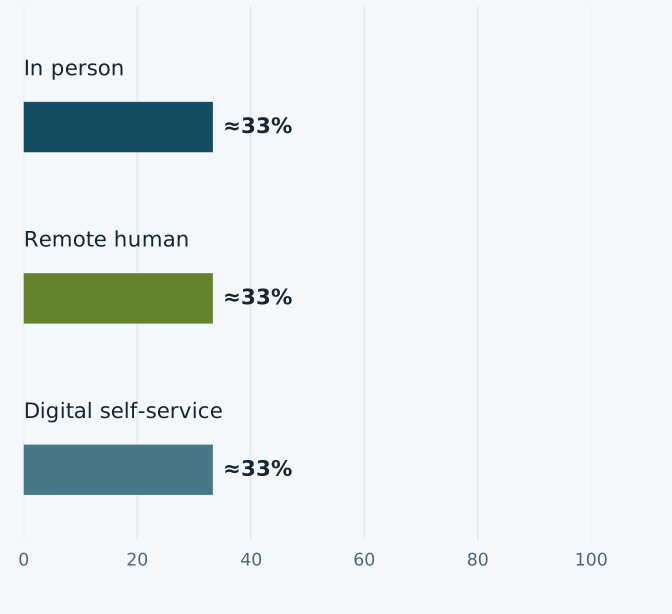
McKinsey’s 2024 B2B research describes a broadly even split between in-person, remote-human and digital self-service interactions. [1] This is a cross-market pattern, not an instruction to divide every partner budget into equal thirds. The useful question is whether the buyer can move between those modes without losing context.
Buyers use a mix of interaction modes
B2B interaction pattern · approximate shares
View chart data
| Measure | Value |
|---|---|
| In person | approximately 33.33% |
| Remote human | approximately 33.33% |
| Digital self-service | approximately 33.33% |
Regional averages also conceal different digital environments. ITU’s 2025 estimates show Internet use of 36% in its Africa region and 70% in its Arab States region. [2] Those population measures do not tell us how a particular business buyer behaves. They reinforce the case for testing the actual route to market instead of assuming a single digital journey works everywhere.
Audit readiness before funding promotion
Ask a prospective campaign partner to explain the offer in the customer’s language. Can the team identify the right application, recognize an unsuitable enquiry and bring in technical support? Can it provide a credible delivery and service explanation? If not, the first investment may need to be enablement rather than demand generation.
The readiness review should also cover practical details: a named commercial owner, current product information, an agreed quotation route and a place to record customer progress. These are modest requirements, but their absence can make a well-produced campaign difficult to convert.
Write one joint value proposition
Avoid combining two company descriptions and calling the result a customer proposition. State the buyer’s problem, the outcome being offered and the contribution of each party. For an integrator relationship, the manufacturer may provide the core technology while the partner contributes application knowledge and local delivery. The exact division must reflect reality.
Then choose proof for that combined offer. A manufacturer’s global reference does not necessarily prove that the local partner can deliver the same scope. Use approved examples, demonstrate the actual team’s capability and identify any support that depends on another location.
Make the handoff explicit
Agree what happens after an enquiry arrives. Define who accepts it, what information is required, how duplicate accounts are handled and when the manufacturer joins the conversation. A rejected lead should carry a reason that marketing can use, such as wrong application, no relevant project or unsupported location.
Choose a response commitment that the teams can meet and review missed handoffs. The purpose is to reduce ambiguity, not to create a universal timing benchmark. Where customer data is shared, follow the organization’s approved consent and data-handling process.
Review progress together
Use a joint account review to distinguish activity from progression. Discuss accepted opportunities, customer objections, technical blockers and the next action. Count unique opportunities once, even when several campaigns or partners contributed. Record influence separately from origination.
The best partner marketing programme creates a learning loop. Market feedback improves the offer, enablement removes recurring obstacles and the next campaign targets a clearer need. More activity becomes valuable only after the underlying relationship can turn attention into a credible customer conversation.
Sources & data notes
Sources checked on 12 September 2026. Observation periods and forecast dates are stated alongside the figures. Recommendations are analysis, not measured outcomes from these studies.
- McKinsey — B2B Pulse 2024: Five fundamental truths ↗
Cross-country, cross-industry B2B survey; a directional benchmark, not a census of MEA industrial buyers.
- ITU — Facts and Figures 2025: Internet use ↗
2025 estimates using ITU regional definitions. Arab States and Africa are not equivalent to Middle East and the whole African continent.
Banner: AI-generated conceptual illustration, not a photograph of a named project. Chart: created from the cited data; any rounding or derived index is identified above.

About the perspective
Channel strategy, distributor programmes and regional customer marketing are central to this approach to joint go-to-market execution.
These articles are personal industry analysis and do not represent an employer’s position or disclose customer project information.
Explore Khaled’s experience ↗