
Keep the discipline of clear positioning, but redesign the evidence, conversion goal and measurement window around the purchase.
An industrial project and a consumer product both need a compelling reason to be chosen. What changes is the decision the marketing must support. A washing-machine shopper may need help comparing features, dimensions and service. A project team buying an industrial system may need to coordinate technical acceptance, installation, finance and responsibility for operating risk.
The mistake is to confuse that difference with “emotional versus rational.” People in both environments want confidence. The evidence and the consequences of being wrong simply differ.
Digital behavior does not remove project complexity
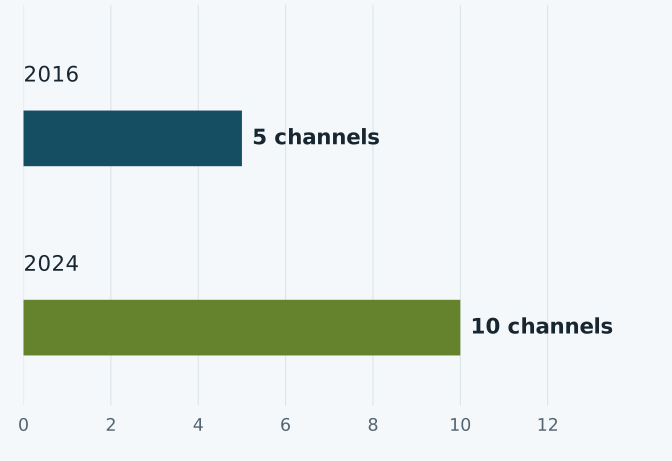
McKinsey’s 2024 B2B Pulse reported an average of ten interaction channels in the buying journey, up from five in 2016. [1] Industrial marketing therefore cannot assume that the sales representative controls every encounter with the brand. Buyers may arrive at a meeting with conclusions already shaped by a website, a partner or an online technical resource.
B2B buying spans more touchpoints
Average interaction channels in the buying journey
View chart data
| Measure | Value |
|---|---|
| 2016 | 5 channels |
| 2024 | 10 channels |
On the consumer side, PwC’s 2024 regional research reported that 78% discovered new brands through social media, versus 67% globally. [2] This is self-reported discovery, not proof that social advertising caused incremental purchases. It does, however, reinforce the need to connect the discovery message with the experience available in store or online.
Change the unit of planning
For consumer products, a useful planning unit may be a shopper segment combined with a product category and retail location. For a major industrial opportunity, start with the account, project and decision group. One account can contain multiple projects, and one project can involve several organizations.
This changes the brief. “Generate more leads” becomes “help the project team resolve the next obstacle.” That obstacle could be an unclear specification, uncertainty about lifecycle cost or a missing local service plan. A technical workshop may be more valuable than a larger volume of broadly targeted enquiries.
Match proof to the consequence of purchase
Consumer communication should make product fit easy to understand: capacity, use case, total price, delivery and after-sales support. Industrial communication should also make interfaces, scope boundaries and application assumptions explicit. A polished case study is useful only if the reference is genuinely comparable and the results can be substantiated.
The shared discipline is clarity. Neither audience benefits from an undifferentiated feature list. Translate each relevant feature into a customer outcome, then show the conditions under which that outcome is credible. Avoid presenting a laboratory result as a guaranteed site result or a product promotion as a complete project solution.
Use different conversion goals
For a retail campaign, a purchase, qualified store visit or product demonstration may be a meaningful near-term action. For a project campaign, the next useful step may be a technical review, a site discussion or inclusion in a defined procurement process. These actions should not be assigned identical value simply because both appear as conversions in an advertising platform.
Agree on stage definitions with sales before launch. Separate contacts from buying accounts and keep the reason for stage progression visible. In consumer reporting, distinguish shipments to retailers from sales to end customers; in project reporting, distinguish quoted value from confirmed business.
Keep the common strengths
Consumer marketing brings valuable discipline in message simplicity, visual consistency and retailer execution. Engineering brings discipline in assumptions, dependencies and evidence. Combining them creates a stronger marketing practice: easy to understand at first contact, detailed enough for scrutiny and measured against the decision the customer actually needs to make.
Sources & data notes
Sources checked on 12 September 2026. Observation periods and forecast dates are stated alongside the figures. Recommendations are analysis, not measured outcomes from these studies.
- McKinsey — B2B Pulse 2024: Five fundamental truths ↗
Cross-country, cross-industry B2B survey; a directional benchmark, not a census of MEA industrial buyers.
- PwC — Voice of the empowered consumer (2024) ↗
Self-reported consumer discovery and purchase influence; not a causal campaign-lift study or an appliance-only survey.
Banner: AI-generated conceptual illustration, not a photograph of a named project. Chart: created from the cited data; any rounding or derived index is identified above.

About the perspective
Moving from civil engineering into consumer-brand and regional customer marketing provides a useful lens for comparing these two buying environments.
These articles are personal industry analysis and do not represent an employer’s position or disclose customer project information.
Explore Khaled’s experience ↗