
During disruption, commercial credibility depends on the accuracy of the promise and the quality of the update.
Regional disturbance becomes a marketing issue when it changes what a customer can safely believe about price, availability and completion. The Red Sea shipping shock offers a documented example. This article examines the late-2023 and early-2024 episode and its commercial lessons; it is not a live assessment of every subsequent conflict or a forecast of current shipping conditions.
What was measured—and what was not
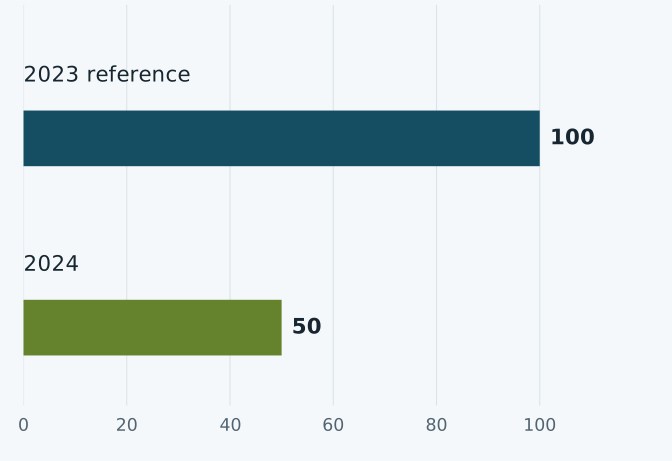
The IMF reported that trade volume through the Suez Canal fell 50% year on year in the first two months of 2024. [1] An earlier UNCTAD January snapshot estimated a 42% fall in weekly Suez transits over the preceding two months. [2] The periods and measures differ, so the percentages should not be combined as a trend series.
A major route under pressure
Suez trade volume · January–February comparison
View chart data
| Measure | Value |
|---|---|
| 2023 reference | 100 |
| 2024 | 50 |
Those numbers describe shipping disruption. They do not show that Middle Eastern manufacturing output fell by the same proportion. Factories, importers and project owners faced different exposures depending on their routes, inventories, sourcing arrangements and customer commitments. The marketing response should begin with that distinction.
Follow the exposure into the customer promise
For a manufacturer relying on an imported component, a delayed arrival can create uncertainty around production scheduling. For a contractor, a late system can complicate coordination with other work. For a consumer-brand distributor, uncertain replenishment can make a promotion harder to execute. These are commercial transmission mechanisms, not quantified claims about every company’s losses.
Map which promoted products depend on affected inputs or routes. Ask operations for the current status of available stock, expected replenishment and alternative configurations. Where facts remain uncertain, the customer message should say what is confirmed, what is provisional and when the next update will arrive.
Replace blanket assurances with bounded commitments
“Business as usual” is a weak message if the account team cannot explain the delivery assumptions behind it. A better response separates stock physically available for allocation from stock in transit and future orders. Sales materials should use the same definitions as the order-management team.
Keep quotation validity and delivery assumptions prominent. If an alternative product or configuration is proposed, have the relevant specialists confirm suitability before promoting it as interchangeable. Marketing can organize the communication, but it should not improvise technical substitutions or contractual commitments.
Adapt campaigns to what can be delivered
When an advertised product becomes difficult to supply, review the campaign quickly. Redirecting demand toward a supported alternative may be sensible; continuing to buy enquiries for an unavailable offer can waste both the customer’s time and the sales team’s credibility.
For industrial accounts, a useful content response could be a supply-status briefing, a maintenance-planning discussion or an explanation of service coverage. For distributors, provide one consistent update that can be adapted to local customers without changing the underlying facts. Do not use a crisis to manufacture urgency that the evidence does not support.
Measure trust as well as demand
Alongside enquiries and opportunities, monitor the proportion of customer commitments that remain accurate, the reasons quotations are revised and the themes behind cancellations or lost orders. These operational indicators help explain campaign performance. A falling conversion rate may reflect changed availability rather than poor creative work.
The lesson is practical: resilience messaging is only as strong as the process behind it. A smaller, more precise promise can be more persuasive than a confident headline that the organization cannot reliably fulfill. In industrial markets, the quality of the update often becomes part of the buyer’s assessment of the supplier.
Sources & data notes
Sources checked on 12 September 2026. Observation periods and forecast dates are stated alongside the figures. Recommendations are analysis, not measured outcomes from these studies.
- IMF — Red Sea Attacks Disrupt Global Trade (7 March 2024) ↗
Suez trade-volume comparison for the first two months of 2024 versus the same period a year earlier.
- UNCTAD — Alarm on escalating global trade disruptions (January 2024) ↗
Earlier two-month snapshot of weekly Suez transits. Different dates and metric from the IMF trade-volume comparison.
Banner: AI-generated conceptual illustration, not a photograph of a named project. Chart: created from the cited data; any rounding or derived index is identified above.

About the perspective
Project-management and regional channel experience connect here: both require coordination between the customer promise and operational delivery.
These articles are personal industry analysis and do not represent an employer’s position or disclose customer project information.
Explore Khaled’s experience ↗