
A national growth target creates context. A supplier still needs a specific buyer, a qualified offer and proof of local capability.
Industrial localization creates an appealing marketing story: local capability, closer supply chains and stronger participation in national development. But broad alignment with a government strategy is not a complete value proposition. A buyer still needs to know whether the supplier can meet the application, deliver the scope and support the installed base.
The opportunity for marketing is to connect national ambition with a specific customer need while making the limits of the supplier’s role clear.
Keep targets separate from achieved activity
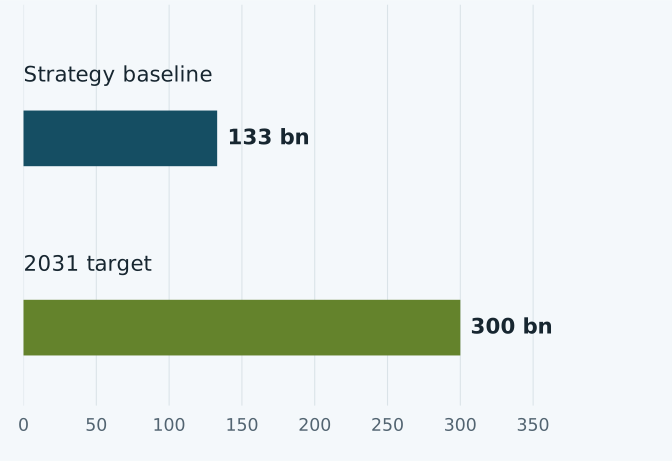
The UAE’s Operation 300bn sets an ambition to raise industrial contribution to GDP from a strategy baseline of AED 133 billion to AED 300 billion by 2031. [1] Separately, MoIAT reported AED 61 billion of local expenditure through the National In-Country Value programme in 2023, up 17% year on year. [2] One is a policy target; the other is a reported programme result. Neither represents the market size for an individual manufacturer.
A strategy target, not booked revenue
UAE industrial contribution to GDP · AED billion
View chart data
| Measure | Value |
|---|---|
| Strategy baseline | 133 bn |
| 2031 target | 300 bn |
These UAE examples should not be treated as a description of every Gulf country’s procurement system. Use each country’s current programme and buyer requirements when preparing an offer. Where eligibility or certification matters, obtain specialist confirmation instead of relying on marketing language.
Define what “local” means in your offer
Local presence can mean several different things: manufacturing, assembly, engineering, inventory, employment, distribution or after-sales service. They are not interchangeable. A locally registered distributor does not automatically make an imported product locally manufactured, and a regional office does not prove local spare-parts availability.
Build a simple evidence record for each claim. Identify the facility or team, the activity performed, the locations served and the documents that substantiate it. Keep this record aligned with procurement submissions, website copy and partner presentations so the buyer sees a consistent account of capability.
Give the customer a business reason to care
Localization is strongest commercially when it solves a customer problem. A nearby technical team may improve coordination. Available parts may reduce uncertainty around a repair. Local training may help a customer operate the system with greater confidence. Each proposition needs evidence appropriate to the claim, rather than a promise that local presence always delivers a particular percentage saving.
For a project campaign, select the customer problem first. Then explain which part of the local operating model addresses it. That is more useful than placing a national-strategy logo next to a standard global product brochure.
Build the partner plan around capability gaps
Partner recruitment should follow the work that must be done. If the gap is application engineering, adding a distributor with reach but no technical support may leave the central problem unresolved. If the gap is coverage, a specialist technical partner may need a separate commercial route to reach buyers.
Agree on responsibilities for opportunity qualification, technical review, installation coordination and support. Give partners approved evidence and a route to resolve questions. Shared campaigns work better when both sides understand who will deliver the promise after the first meeting.
Measure the offer’s readiness
Before scaling promotion, check whether the relevant buying organizations accept the proposed route to market, whether documentation is complete and whether delivery responsibilities are clear. Track qualified accounts and accepted opportunities rather than counting every national investment announcement as potential pipeline.
The strongest industrial localization story is specific enough to be checked. It explains what is available locally, how that capability benefits the buyer and what remains dependent on the wider supply chain. That precision builds trust without turning a national ambition into an unsupported commercial claim.
Sources & data notes
Sources checked on 12 September 2026. Observation periods and forecast dates are stated alongside the figures. Recommendations are analysis, not measured outcomes from these studies.
- UAE Government — Operation 300bn industrial strategy ↗
AED 133 billion strategy baseline and AED 300 billion target for 2031; the target is not an achieved result.
- MoIAT — 2023 industrial achievements (17 January 2024) ↗
Ministry-reported 2023 National In-Country Value programme spending; not the size of a particular product market.
Banner: AI-generated conceptual illustration, not a photograph of a named project. Chart: created from the cited data; any rounding or derived index is identified above.

About the perspective
Regional partner development and an engineering background inform the focus on procurement readiness, service capability and measurable customer value.
These articles are personal industry analysis and do not represent an employer’s position or disclose customer project information.
Explore Khaled’s experience ↗