Use global sustainability data to explain relevance, then use site-specific evidence to support the investment case.
Energy efficiency is an attractive theme for building-technology marketing because it connects operating cost, asset performance and environmental ambition. It is also easy to overstate. A global emissions statistic can establish why buildings matter; it cannot prove how much a particular control system will save at a specific site.
The strongest proposition connects the two levels of evidence without confusing them. It explains the scale of the problem, then makes the customer’s own assumptions visible.
Use the sector data as context
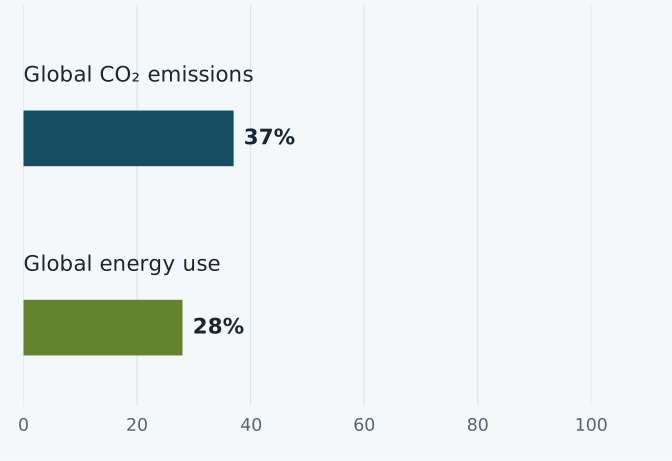
UNEP’s 2025–2026 buildings report describes the sector as responsible for around 37% of global CO₂ emissions. [1] GlobalABC reports a 28% share of global energy consumption and a global building floor area of 273 billion square metres in 2024, up 1.7% that year. [2] These are global sector indicators, not estimates for MEA buildings or the addressable revenue of a supplier.
Buildings have a large global footprint
Sector shares reported in the 2025–2026 report
View chart data
| Measure | Value |
|---|---|
| Global CO₂ emissions | 37% |
| Global energy use | 28% |
The emissions and energy shares have different denominators and should not be added. Nor should either number become a shortcut to a claim about the savings available from one product. The customer’s building type, existing systems and operating conditions remain central.
Start with a defensible baseline
Before promoting a savings figure, ask what the comparison is. Is the baseline an actual operating period, a modeled design or a different equipment configuration? Does the comparison account for changes in occupancy, weather, operating hours and comfort requirements?
Marketing does not need to perform the engineering study, but it should make the study’s boundary understandable. A case study should identify what changed, how the result was measured and which conditions may limit transfer to another building. If that evidence is unavailable, describe the intended capability instead of publishing a numerical performance claim.
Translate performance into the buying decision
Facilities teams may prioritize maintainability and system visibility. Finance may ask about investment, operating costs and uncertainty. A consultant may need documentation on compatibility and design requirements. The proposition should connect these concerns rather than presenting sustainability as a separate, decorative message.
For a business-case asset, show the relevant cost categories and label assumptions. Include implementation effort and ongoing support where they are part of the scope. Avoid implying that a simple purchase-price comparison captures the whole lifecycle decision.
Make claims easy to check
Use precise language about the system boundary. A product can contribute to efficiency without making an entire building “net zero.” An individual reference can demonstrate a result without guaranteeing the same outcome elsewhere. These distinctions protect credibility and help the sales team have a more useful conversation.
Where a claim depends on a certification, test or model, identify it accurately and provide a route to the supporting document. Keep technical and marketing versions aligned. If the equipment, software or operating method changes, review the claim before reusing the original asset.
Turn the campaign into a diagnostic conversation
A useful call to action might invite the customer to discuss a defined operational challenge, share a system requirement or arrange a suitability review. That is more meaningful than collecting general interest under an oversized savings headline.
Measure the quality of the resulting discussions: whether a baseline can be established, whether the proposed application is suitable and whether the buyer has a next decision to make. Good energy-efficiency marketing makes the investment case easier to inspect. It earns attention with a relevant problem and earns trust by making the evidence—and its limits—clear.
Sources & data notes
Sources checked on 12 September 2026. Observation periods and forecast dates are stated alongside the figures. Recommendations are analysis, not measured outcomes from these studies.
- UNEP — Global Status Report for Buildings and Construction 2025–2026 ↗
Global sector-level emissions and materials context; no claim about the savings from a specific product.
- GlobalABC — Global Status Report: 2024 building stock data ↗
Reports 2024 floor area, growth and sector energy share. Live report page accessed 12 September 2026.
Banner: AI-generated conceptual illustration, not a photograph of a named project. Chart: created from the cited data; any rounding or derived index is identified above.

About the perspective
Engineering, infrastructure and smart-building customer marketing experience inform the emphasis on technical assumptions and commercially useful evidence.
These articles are personal industry analysis and do not represent an employer’s position or disclose customer project information.
Explore Khaled’s experience ↗