
Use regional indicators to ask better questions; use city-, account- and workload-level evidence to allocate budget.
“Middle East and Africa” is a useful management label, but an incomplete market strategy. A buyer serving a financial-services workload, a telecom operator adding capacity and an industrial customer considering local hosting can have different decision criteria even within the same city. Geography matters, but it should not be the only segmentation variable.
Read regional statistics without flattening the market
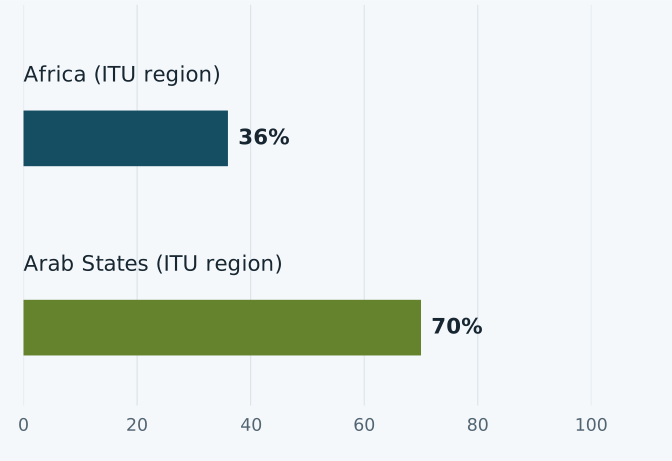
ITU’s 2025 estimates put Internet use at 36% in its Africa region and 70% in its Arab States region. [1] These groupings do not map neatly onto the whole African continent and the Middle East, and population connectivity is not a measure of enterprise cloud spending. The figures are useful context for digital inclusion; they are insufficient to rank individual data center opportunities.
Connectivity is uneven
Individuals using the Internet · 2025 ITU estimates
View chart data
| Measure | Value |
|---|---|
| Africa (ITU region) | 36% |
| Arab States (ITU region) | 70% |
Compare that broad context with a specific supply-side signal: AWS’s March 2024 Saudi announcement described more than US$5.3 billion of planned investment. [2] A named investment plan and a regional connectivity percentage answer different questions. Neither should stand in for a verified list of customers that your organization can win.
Segment the opportunity on four dimensions
My starting point would be a matrix of workload, buyer, delivery route and operational support. Workload describes the problem being solved. Buyer identifies who owns the budget. Delivery route clarifies whether you sell directly, through an integrator or through a contractor. Support tests whether the promise remains credible after installation.
For example, a campaign aimed at an enterprise evaluating colocation might explain migration support and service boundaries. A campaign for an infrastructure contractor should concentrate on technical coordination and installation readiness. These are alternative buying situations, not country stereotypes.
Within each selected country, examine the specific city, connectivity options, project phase and partner footprint. A large national opportunity can still be commercially inaccessible if the required approval route or local support capability is missing.
Localize the evidence, not just the language
Translation is only one part of localization. An English or Arabic asset can still fail if it uses irrelevant customer examples, unavailable products or a contact route that leads to another time zone without a clear handover.
- State which locations the offer can currently serve.
- Match technical documents to the equipment and configuration actually available.
- Explain how the local partner and the manufacturer divide responsibilities.
- Use customer references only where permission and comparable operating conditions exist.
Where buyers ask about data location or sector requirements, route the question to the appropriate technical and legal specialists. Marketing should not turn a general preference for local hosting into an unsupported claim that every workload is legally required to stay in-country.
Allocate budget by readiness
Separate market-development accounts from active opportunities. The former may need educational content and partner recruitment; the latter may need a workshop, a technical comparison or support with an internal business case. Expecting both groups to convert on the same schedule creates misleading performance reports.
Before expanding a campaign, review the reasons accounts did not progress. Was the need unqualified, the procurement timing premature, the route to market unclear or the service promise unconvincing? Each answer implies a different corrective action. None is solved automatically by adding countries to the media plan.
A better regional dashboard
Compare markets using consistent definitions for qualified accounts, accepted opportunities and stage progression. Then display the local context beside the totals. The purpose is not to force every country onto an identical curve; it is to understand where evidence supports investment and where the organization still needs to earn the right to compete.
Sources & data notes
Sources checked on 12 September 2026. Observation periods and forecast dates are stated alongside the figures. Recommendations are analysis, not measured outcomes from these studies.
- ITU — Facts and Figures 2025: Internet use ↗
2025 estimates using ITU regional definitions. Arab States and Africa are not equivalent to Middle East and the whole African continent.
- AWS — Saudi Arabia infrastructure Region announcement (4 March 2024) ↗
Company announcement of planned investment; not proof of completion or supplier-accessible expenditure.
Banner: AI-generated conceptual illustration, not a photograph of a named project. Chart: created from the cited data; any rounding or derived index is identified above.

About the perspective
This country-by-country planning approach draws on channel and partner marketing across multiple regional markets, rather than assuming one regional campaign fits all.
These articles are personal industry analysis and do not represent an employer’s position or disclose customer project information.
Explore Khaled’s experience ↗